


Background:
The Universal Properties of Acceleration are the fundamental laws for acceleration in the universe and apply in all circumstances of acceleration including observer invariant secondary universal radial expansion which creates the illusion of gravity as well as the architecture of planetary and stellar geology.
The Universal Properties of Acceleration preclude the necessity of separate gravitational laws as all acceleration follow the same precise format.
Special Relativity (SR) is based upon the concept that the size of all mass in the universe needs to be absolute. However, the eminent scientist Jules Henri Poincarè stated in his book, Science and Method (1897) that the size of everything in the universe need not be absolute, laying the groundwork for a potential universe that is constructed by mass that is both normally expanding and accelerating.
Albert Einstein, believed only the human observer to be of consequence and therefore disregarded Poincaré s belief in a potential non-absolute size for all mass and he became the chief proponent of SR, that described only a static universe where the size of all fundamental mass remains constant. This strict adherence, was founded by Einstein’s Principle of Equivalence which had the consequence of maintaining a prison wall boundary that prevented scientists from discovering the true nature of reality for a hundred years. Equivalence was an admission that gravity is created by inertia, which is the natural physical reaction to acceleration. But since Einstein could find no physical justification for it, as he saw nothing accelerating, he settled for just the numerical equivalent of inertia. Knowing that gravity was somehow related to some kind of invisible acceleration he called gravity an illusion created by the proximity of a mass. This was his foundation for General Relativity.
But the possibility of size not being absolute figures perfectly with a universe that is expanding and accelerating from both the particle and energy level. This prospect allows for the establishment of a dual observation of nature as a result of the scientific principle called observer -invariance.
Reality therefore has two possible observations. One based upon the human observer that is an integral member of an accelerating frame of reference that cannot see any motion because of observer -invariance including all measurements derived by devices that are integral members of the same accelerating frame. The other is the observation of a non- participating member observer that can “see” the motion of all acceleration in the frame of reference from some hypothetical outside position of reference. For example: an observer that sees the sun moving across the sky verses an observer that is outside the box of observer invariance and can “see” the turning of planet Earth. This seeing constitutes a knowledge of truth even if it cannot be directly observed. This duality is a fundamental truth that exists in both the macro world and the quantum world.
Observer-invariance
The most important and overlooked scientific principle for understanding how the universe works.


What we know to be true may be closer to reality than what we see. Being sure of what we are looking at can be an error that we never realize.
In a universe that expands and accelerates from the energy and particle level, observation is a very limited form of truth.
There now exists newly revealed evidence that water in a waterfall always observed to be going down, actually is moving up. But this uncovered truth is so mind boggling to most humans that it could never be accepted. Therefore, it may remain hidden forever.
This “truth” can be explained in detail but can be difficult to accept.
Understanding the Universal Properties of Acceleration is essential to understanding how the universe works.

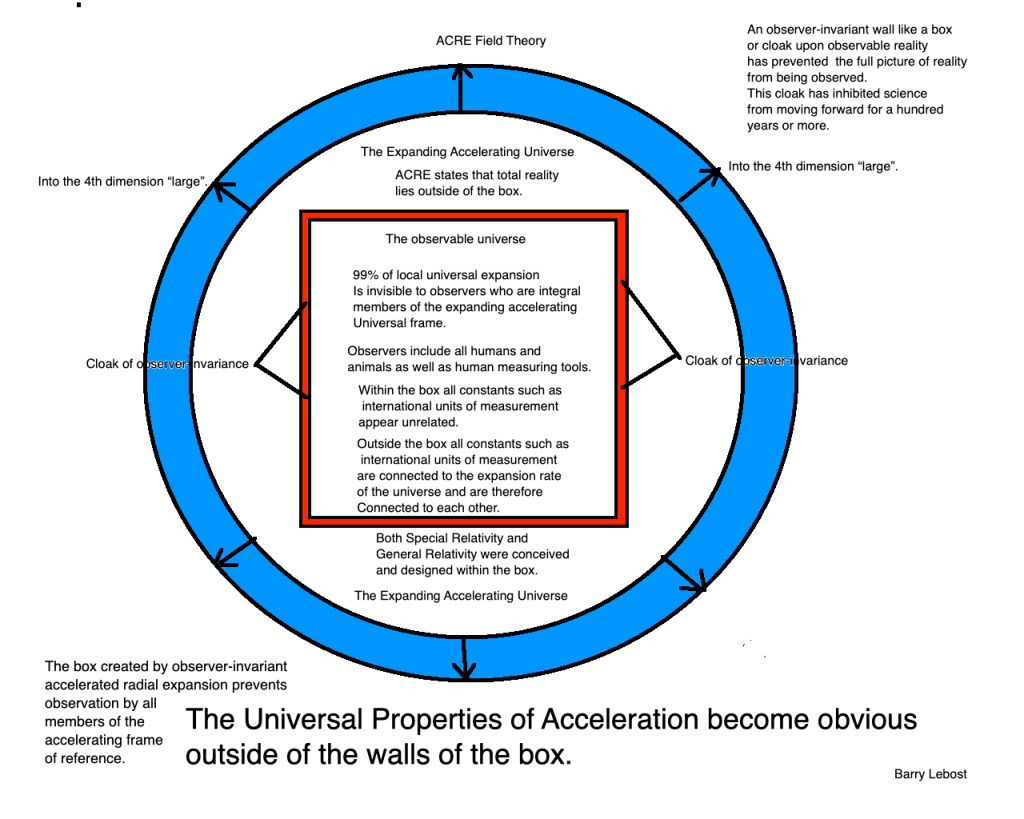
 ACRE Field Theory
Leave a comment